Why Do We Target a 3x Multiple Over Three Years
Thursday 13 August 2026A target of 3x over three years may seem high. It is. But it must be understood in light of the risks involved in financing a video game.
A target of 3x over three years may seem high. It is. But it must be understood in light of the risks involved in financing a video game.
In practical terms, a 3x multiple means that a €100 investment would return €300 in total, including the initial capital. If the entire amount were paid after three years, this would be equivalent to an annualised return of approximately 44%.*
However, this is a target, not a guaranteed return. A high potential return always comes with a high level of risk.
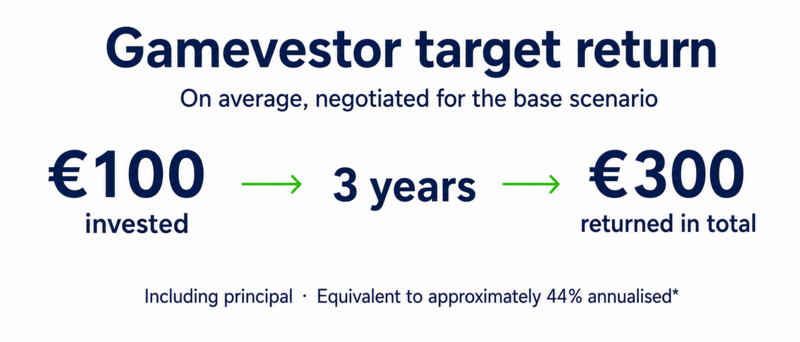
*Theoretical calculation based on a single €300 payment after three years, excluding taxes.
Why Can a Game Generate a High Multiple?
Most of a game’s costs are incurred before launch, including production, graphics, technology, testing and marketing.
Once launched, digital distribution allows the game to be sold at scale without having to manufacture each additional copy. If the title finds its audience, its revenue can therefore grow much faster than its costs.
Revenue sharing allows investors to benefit directly from this dynamic. Their return does not depend on the studio’s overall profits, but on the eligible revenue generated by the game they financed.
The studio therefore does not need to be sold or become profitable as a whole before it can begin distributing revenue to investors.
This model creates significant potential, but it also works in the opposite direction: if the game sells poorly, the amounts distributed will be low or potentially non-existent.
How Do We Build This Target?
For each project, we assess several commercial scenarios. These take into account factors including:
The potential number of copies sold
The average selling price and net revenue per copy
The distribution of sales over time
The eligible revenue defined in the contract
The percentage allocated to investors
The planned duration of the revenue-sharing period
Based on these projections, we negotiate the revenue-sharing terms with the studio, including the eligible revenue, the percentage allocated to investors and the contract duration.
The objective is to reach an agreement that meets the studio’s financing needs while targeting a return of approximately 3x over three years for investors under our base scenario.
These terms are then contractually defined. However, the actual return remains dependent on the game’s commercial performance and may be higher or lower than estimated.
Why a Three-Year Horizon?
Gamevestor prioritises projects that are already sufficiently advanced for us to assess their production, budget, timeline and commercial potential.
The objective is for the game to launch and generate a significant share of its revenue within three years of the investment. This period covers the final stages of development, the game’s commercial launch and the first distributions to investors.
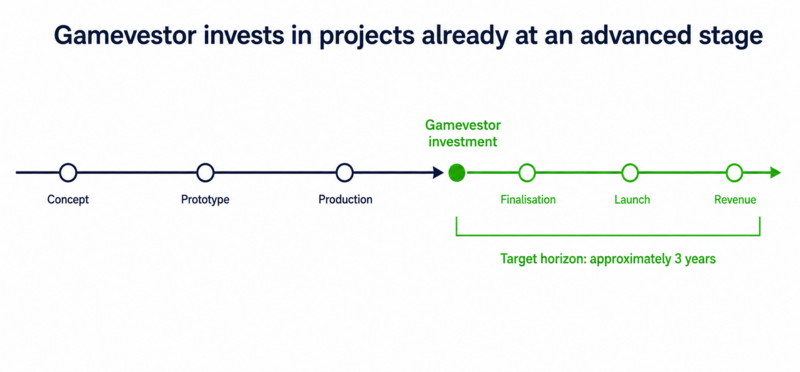
However, three years remains a target horizon, not a guaranteed deadline. Production delays or a more gradual sales curve may postpone distributions, even if the game ultimately reaches the expected revenue level.
Is a 3x Multiple Over Three Years Realistic?
This multiple is achievable when a game remains on schedule and generates the sales projected under the selected scenarios. Some titles may exceed this target. Others may return less, take longer or result in a loss.
Today, this target is based on the financial projections of the projects selected by Gamevestor. It will ultimately need to be measured against their actual commercial results.
This is also why diversification across several games is essential. In an industry where performance varies significantly from one title to another, the outcome of a portfolio is rarely driven equally by every project.
A Selection Target, Not a Guarantee
The target multiple of 3x over three years is neither a promise nor a contractual return. It is a criterion used to select projects whose potential we believe is consistent with the risks taken by investors.
The terms, scenarios and risks specific to each game are presented before investment. Investors should review them carefully, diversify their investments and only invest amounts they can afford to lose. As the French Financial Markets Authority reminds investors, no high return can ever be guaranteed.

Ivan Marchand — President and cofounder of Gamevestor. Over 15 years in tech and video games, including at EA, Google and Amazon.