Why Indie Games Are the Future of Gaming in 2026?
Monday 17 August 2026Indie games generated an estimated $4.5 billion on Steam in 2025 - around 25% of the platform's entire revenue.
Why Indie Games Are the Future of Gaming in 2026
Indie games generated an estimated $4.5 billion on Steam in 2025 - around 25% of the platform's entire revenue. That share has been climbing for years, and a global shortage of computer memory is about to accelerate it.
Here's why.
Why are GPU prices rising in 2026?
AI data centers are projected to consume up to 70% of the world's memory output in 2026, against 20–30% in 2022. Graphics cards need that same memory, so they now compete against buyers who barely notice the price.
The result: GPUs are selling around 16% above their official price globally. Valve's Steam Machine, targeted internally near $750, launched at $1,049.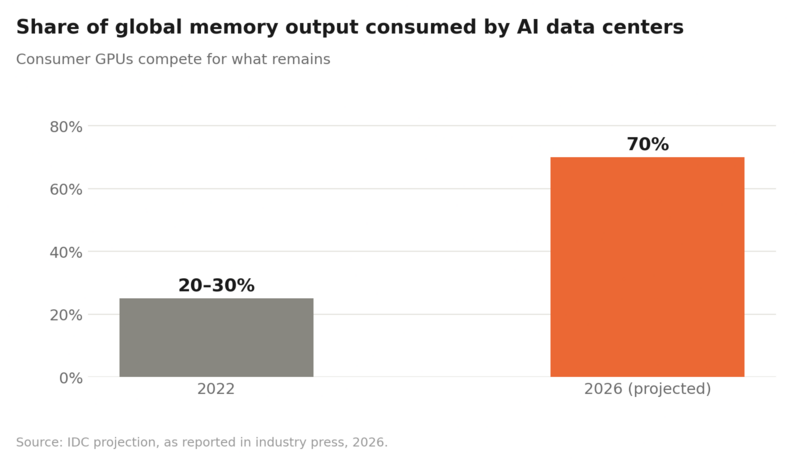
Are gamers still upgrading their hardware?
Not quickly. As of July 2026, the most common graphics card on Steam is still the RTX 3060 - released in 2021. Cards with 16GB of video memory only overtook 8GB cards in July 2026, years after 16GB became the standard target for new AAA development.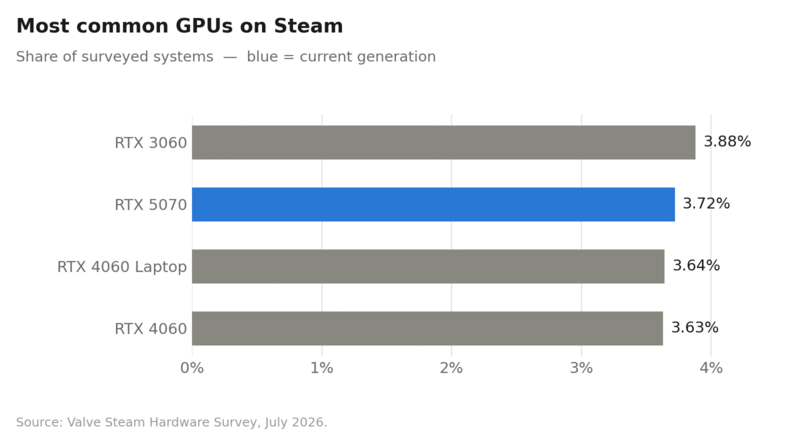
Players aren't refusing to upgrade. They're waiting for prices that make sense.
Why does this hurt AAA games?
A blockbuster game now costs $200–300 million to produce, before marketing. In 2010 it was $50–80 million.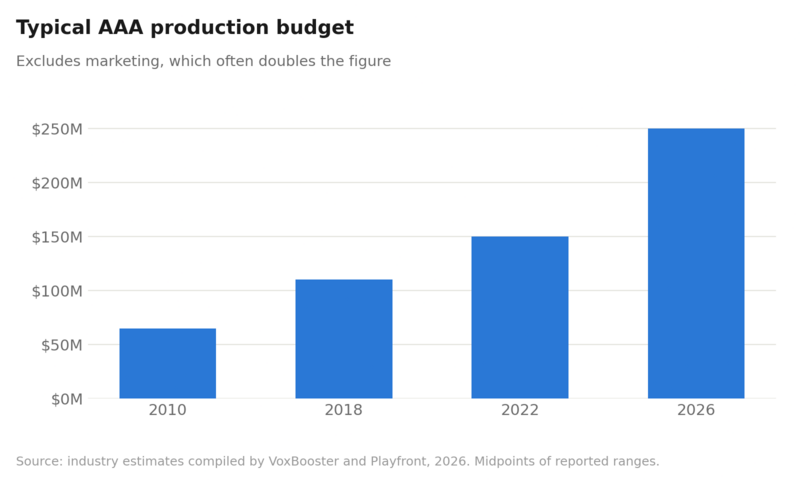
Most of that increase went into visual fidelity - and fidelity only sells if players own hardware capable of displaying it. When the installed base stops moving, the most expensive part of a AAA budget becomes the part the market can't see.
The industry is already absorbing this. Two-thirds of AAA studios reported layoffs in the past twelve months.
How much money do indie games actually make?
More than most people assume, and growing far faster:
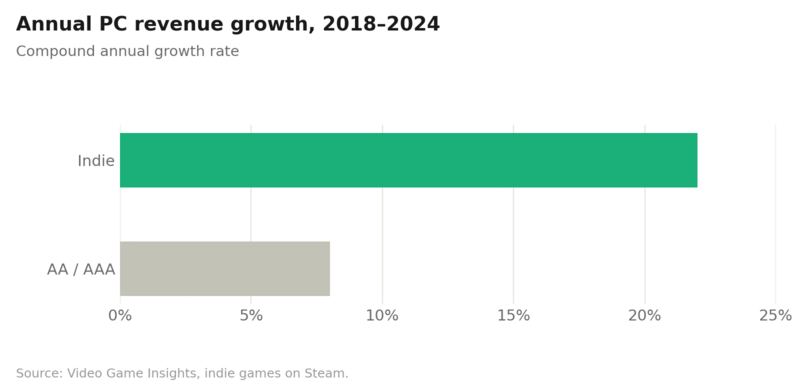
Indie PC revenue grew roughly 22% per year from 2018 to 2024. AA and AAA grew about 8%.
Indies reached 48% of full-game revenue on Steam by late 2024, double their 24% share in 2018.
The top five indie releases of 2025 earned over $500 million combined.
Schedule I alone made $151 million - built by a single developer.
Why are indie games a strong bet for the future?
Because the constraint has changed. When hardware improvement slows, no budget can buy an advantage in graphics that players can't render. What's left is design - systems, novelty, social play - and that's the dimension where a $2 million game can genuinely outperform a $250 million one.
That's not a prediction about taste. It's arithmetic about where returns are available.
One caveat matters: the indie market is winner-take-all. Around 20,000 indie games shipped on Steam in 2025, and only about 300 earned more than $1 million. The category is growing fast; individual outcomes remain highly uncertain. Selection is everything.
How can you invest in indie games?
Gamevestor lets you invest from €100 into selected PC and console games, through a financial instrument granting a share of the revenue those games generate. Funds are released against real development milestones, and the platform is authorised by the AMF.
See the projects currently open →
Investing carries a risk of total capital loss and illiquidity. Past performance does not predict future results.

Ivan Marchand — President and cofounder of Gamevestor. Over 15 years in tech and video games, including at EA, Google and Amazon.