How to invest in Video Games in 2026?
Monday 17 August 2026Stocks, ETFs, or Direct Game Financing? Video games have become the world’s largest entertainment industry.
How to invest in Video Games in 2026: Stocks, ETFs, or Direct Game Financing?
Video games have become the world’s largest entertainment industry, surpassing film and music combined. With a market estimated at more than $250 billion in 2026, annual growth of 8% to 10%, and 3.5 billion players worldwide, the industry is attracting a growing number of investors seeking exposure to this momentum.
But how can you actually invest in video games?
Three main options are available to individual investors: publicly listed stocks, gaming ETFs, and direct game financing. Each corresponds to a different risk profile, investment horizon, and level of involvement. This guide explains how they work, along with their respective benefits and limitations.
1. Gaming Stocks: Investing in the Industry’s Giants
Investing in the video game industry through the stock market means buying shares in listed companies, including publishers, developers, hardware manufacturers, and semiconductor companies. It is the most direct and liquid way to expose a portfolio to the industry’s growth.
The Key Players in 2026 and Their Recent Performance
Nintendo remains one of the industry’s leading companies, driven by the rapid success of the Switch 2. More than 15 million units were sold within six months, prompting the company to raise its full-year forecast to 19 million units.
Nintendo shares gained 21.6% in 2024 and 20.1% in 2025, reaching a peak of $22.82 in August 2025. However, enthusiasm cooled sharply in 2026. Rising RAM costs, fuelled by demand from the AI industry, have put pressure on Switch 2 margins. As a result, the stock lost almost 49% from its peak and was trading at approximately $12 by the end of July 2026.
Consumer demand remains strong. The market is primarily reacting to the company’s cost structure.
Take-Two Interactive is currently one of the industry’s most closely watched stocks, largely because GTA VI is scheduled for release on 19 November 2026.
Pre-orders opened in late June and reportedly broke records. According to one French retailer, the game received six times as many pre-orders within 24 hours as the entire Call of Duty franchise did over the same period.
Take-Two shares were trading at approximately $245 in mid-2026, supported by FY2026 revenue growth of 18% to $6.66 billion. Of the 28 analysts covering the stock, 25 rate it as a buy, with a consensus price target of $277.
This is a typical example of a company whose share price already reflects much of the anticipated success. Further upside remains possible, but any disappointment could be severely punished by the market.
Sony has followed a more stable trajectory over the past two years. The company completed a five-for-one stock split in September 2024 and recorded several record quarters, including Q2 FY2025 sales of ¥3.1 trillion, up 5% year over year.
After reaching a peak of $30.18 in November 2025, the stock has traded at approximately $22 to $23. Sony’s diversified business model, spanning gaming, image sensors, and entertainment, helps absorb industry-specific shocks. This makes it one of the more defensive gaming-related stocks.
Ubisoft is a textbook example of what can go wrong.
After declining 47% in 2024 and another 43% in 2025, Ubisoft shares are trading below €6, giving the company a market capitalisation of approximately €750 million. This compares with a peak share price of €120 in 2018, representing a 93% destruction of shareholder value in eight years.
The company reported a net loss of €159 million for FY2025 and expects revenue to decline by another 8% to 9% in FY2026–27. Few companies illustrate more clearly how poor execution of a gaming strategy can damage an investment portfolio.
Four companies from the same industry, four radically different trajectories: this is the reality of investing in gaming stocks.
The Limitations of This Approach
Investing in large listed studios primarily exposes investors to their overall corporate strategy, including intellectual property, acquisitions, subscriptions, and management decisions.
The connection between the success of a particular game and the performance of the company’s stock is therefore indirect and influenced by many other factors.
2. Gaming ETFs: Ready-Made Diversification
An ETF, or exchange-traded fund, is a publicly traded fund designed to track an index or a specific market segment. A gaming ETF allows investors to buy exposure to a basket of companies representing the industry through a single transaction, without having to select individual stocks.

The Main Gaming ETFs
The VanEck Video Gaming and eSports ETF, known as ESPO, is one of the leading gaming ETFs worldwide.
It tracks the MVIS Global Video Gaming & eSports Index and includes companies such as Nintendo, Tencent, Nvidia, Electronic Arts, and Activision. In July 2026, the fund was trading at approximately $88 per share, with $231 million in assets under management and an annual management fee of 0.56%.
Its year-to-date performance of approximately -14% as of 24 July 2026 reflects broader pressure on technology and consumer-discretionary stocks at the beginning of the year rather than a structural weakness in the gaming industry.
This is precisely the purpose of an ETF: to absorb company-specific shocks through diversification.
Advantages and Disadvantages
Gaming ETFs offer liquidity, simplicity, and diversification within a single financial instrument. They are suitable for investors who want exposure to the industry without having to analyse individual companies.
The trade-off is that investors cannot choose the games or studios they consider most promising. They invest in the entire industry, including its weakest-performing companies.
Management fees, although relatively moderate at approximately 0.4% to 0.7% per year depending on the fund, also reduce long-term returns.
3. Direct Game Financing: Investing Like a Producer
Direct game financing is the newest and most disruptive model.
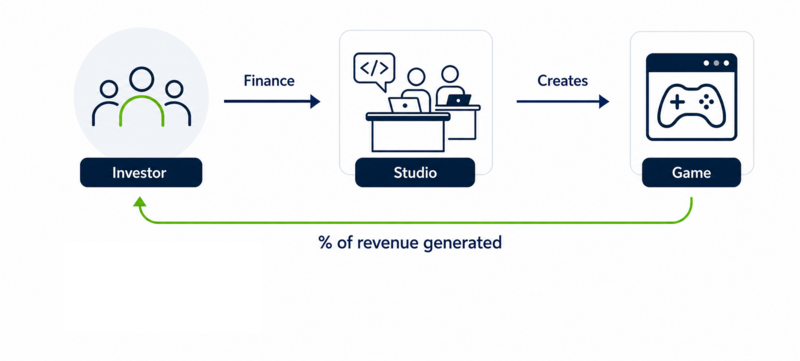
It consists of directly financing the development of a video game in exchange for a share of the future revenue generated by that game, without buying shares in a company and without investing through the stock market.
How Does It Work?
The model is based on revenue sharing.
As an investor, you contribute capital towards the development of a game. If the game is released and generates sales, you receive a predefined share of its revenue, proportional to your investment, until the agreed return conditions are reached.
Gamevestor: The Regulated Platform Dedicated to Game Financing
Gamevestor is the first European crowdfunding investment platform entirely dedicated to video games and regulated by the AMF, the French Financial Markets Authority.
The Gamevestor model is based on several distinctive principles.
Rigorous Project Selection
Every game is analysed by an experienced team before being presented to investors. The review covers the development team, budget realism, previous experience, production plan, and commercial potential.
Milestone-Based Financing
Funds are released progressively as predefined development milestones are completed.
This mechanism helps reduce the risk of budget overruns and encourages studios to maintain financial and operational discipline throughout production.
A Dedicated SPV Structure
Each investment is made through a dedicated special-purpose vehicle, or SPV, designed to structure and legally protect investors’ rights.
Transparent Revenue Sharing
The revenue share, return conditions, and contractual cap are established before the investment is made.
Returns are not based on a speculative stock-market valuation. Investors receive payments if and when the game generates revenue, according to the agreed contractual terms.
What Stocks and ETFs Cannot Offer
No gaming ETF allows an investor to participate directly in the revenue generated by a specific game.
Buying ESPO means investing in the industry as a whole, including both its successes and its weaker performers. Buying Nintendo shares means investing in Nintendo’s overall corporate strategy, not specifically in the next Zelda title.
Direct financing changes the model.
Investors select an individual project, understand what they are financing, and participate contractually in its commercial performance if the game succeeds.
This is similar to the model traditionally used by major publishers and specialist venture-capital funds. Gamevestor makes it accessible to individual investors.
The expected investment horizon is generally two to four years. For an investor who believes in the potential of a project, this is the time required for development, launch, and commercial value creation.
It is not simply a disadvantage. It is part of the mechanics of early-stage investing.
Comparison: Which Investment Vehicle Should You Choose in 2026?
Criterion
Listed stocks
Gaming ETFs
Direct financing through Gamevestor
Returns linked to the success of one game
Indirect
Highly diluted
Direct and contractual
Access to early-stage projects
No
No
Yes
Potential for a 2x to 5x return
Possible
Rare
Central to the model
Annual management fees
None
0.4%–0.7%
None
Ability to choose the project
Partially
No
Yes, project by project
Regulation
AMF / SEC
AMF / SEC
AMF, with ECSP authorisation
Investment horizon
Short term
Short term
Medium term, two to four years
What Strategy Should Investors Adopt?
These three approaches are not mutually exclusive. They can naturally complement one another.
A well-constructed gaming portfolio could combine:
An ETF such as ESPO for broad, long-term exposure.
A small number of individual stocks, such as Nintendo or Microsoft, based on strong convictions.
A dedicated allocation to direct game financing to capture a more asymmetric return profile.
Direct financing is where investors can access projects with the potential to multiply their initial investment, without the management fees and structural constraints of a traditional investment fund.
This is precisely Gamevestor’s proposition: giving individual investors access to an asset class that was previously reserved for major publishers and specialist venture-capital funds.
The key difference is that investors choose the game themselves rather than delegating that decision to a fund manager.
Conclusion
Video games are now a mature industry with sustained growth, supported by powerful structural trends including subscriptions, cloud gaming, generative AI applied to development, and expansion across emerging markets.
The investment opportunities are real, but investors need to select the right vehicle for their objectives and risk profile.
Listed stocks provide liquidity and exposure to the industry’s largest companies, but they can be highly volatile. Gaming ETFs simplify access and provide diversification, but they also dilute the impact of exceptional performers.
Direct game financing, as offered by Gamevestor, opens a third path: investing in selected projects, receiving a contractual share of their revenue, and participating directly in the creation of video games.
Ready to invest in the next potential success?
Discover the projects currently open for investment on Gamevestor.co. Gamevestor is regulated by the AMF and accessible from an investment of a few hundred euros.
This article is provided for informational purposes only and does not constitute investment advice. All investments involve a risk of partial or total loss of capital. Consult a financial adviser before making any investment decision.

Ivan Marchand — President and cofounder of Gamevestor. Over 15 years in tech and video games, including at EA, Google and Amazon.