Investing in a Game or a Studio: What’s the Difference?
Thursday 13 August 2026When you invest in a game through Gamevestor, you are not buying a stake in the studio developing it.
When you invest in a game through Gamevestor, you are not buying a stake in the studio developing it. You finance a specific project and receive a share of the revenue it generates, under terms defined upfront.
Legally, the investment takes the form of bonds. Economically, it works more like royalties: when the game generates revenue, a portion is distributed to investors.
We chose this model because it better reflects how value is created in the video game industry.
Investing in a Company vs. Investing in a Project
When you buy shares in a studio, you invest in the entire company. Your return depends on the growth of its value, potential dividend payments or the eventual sale of your shares. You are therefore exposed to its entire business: its different games, costs, hiring decisions and overall strategy.
With revenue sharing, you invest in a specific game. You subscribe to bonds that entitle you to a share of the revenue generated by that game. Your return is therefore directly linked to its commercial performance.
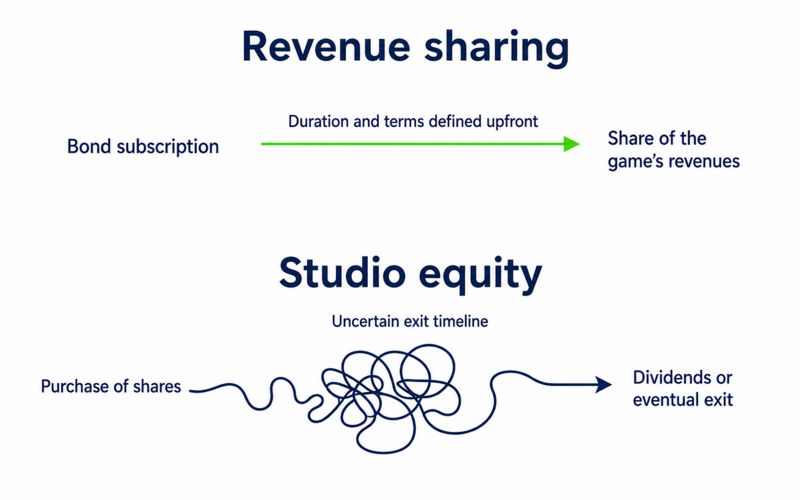
This distinction matters in the video game industry, where a studio’s success may depend on one particular title. Revenue sharing allows you to choose the project you want to finance and clearly understand what will determine your potential return.
Revenue Rather Than Profits
A game can sell very well without the studio itself being profitable. Salaries, production costs and investments in future projects can absorb a significant portion of its earnings.
With equity, investors benefit from the overall value created by the company. With revenue sharing, a predefined portion of the revenue generated by the game’s sales is distributed to investors under the agreed terms.
Investors therefore do not need to wait for the studio to become profitable, pay dividends or be sold.
A Model Suited to the J-Curve of Game Development
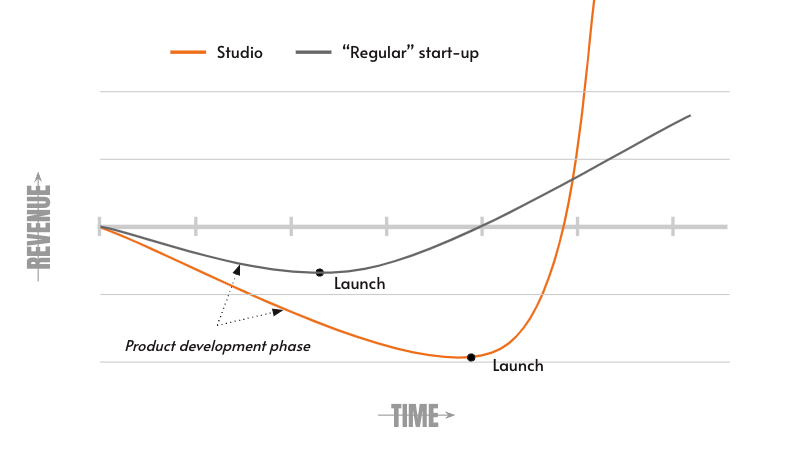
Developing a game requires several months—and sometimes several years—of investment before it generates any revenue. During this period, the studio must finance production, graphics, technology, testing and marketing.
Revenue only begins after launch. If the game finds its audience, it can then grow quickly and offset the costs incurred during development.
This dynamic is known as the J-curve: an initial investment phase during which costs accumulate, followed by significant growth potential after launch.
Unlike a conventional company, whose value may develop more gradually, a game concentrates much of its risk and potential around a single release.
Revenue sharing follows the same cycle. Investors help finance the game before launch and then receive a share of the revenue it generates. The financing structure is therefore directly aligned with the project’s economic reality.
Rules Defined Upfront
Equity investing requires an understanding of the company’s valuation, the percentage of capital held, potential dilution and the conditions of a future exit.
With revenue sharing, the main rules are established before the investment is made: which revenues are eligible, what share is allocated to investors and how long the revenue-sharing period lasts.
This makes the model easier to understand, particularly for people who know the video game industry well but are not venture capital specialists.
Studios Retain Their Independence
Equity financing requires a studio to give up part of its ownership. New shareholders may then participate in its governance and influence future decisions.
Revenue sharing does not transfer ownership of either the studio or its games. The studio retains its equity, intellectual property and creative independence.
Investors participate in the game’s commercial performance without becoming involved in the management of the company.
A Shared Interest: The Game’s Success
The studio and its investors share the same objective: for the game to find its audience and generate sales.
Equity remains an excellent way to finance the overall growth of a company. But when financing a clearly identified game, revenue sharing provides a more direct, transparent model that is better suited to the project’s lifecycle.
The studio retains control of the project, while investors benefit from its commercial success under the terms defined in the contract.

Ivan Marchand — President and cofounder of Gamevestor. Over 15 years in tech and video games, including at EA, Google and Amazon.